RehabPath is a behavioural coaching platform that keeps patients engaged with their physiotherapy programme — through the critical window when motivation fades and adherence fails.
↑ Illustrative pacing. Adherence tends to drop at the same point pain eases (~week 4) — but healing isn't complete until ~week 10. RehabPath operates in that gap.
Research consistently shows that patients don't fail rehab because they don't understand it. They fail because motivation collapses the moment pain subsides — long before the body is actually healed.
RehabPath combines a patient-facing app with a behavioural messaging engine that adapts to each person — surfacing the right motivation at the right moment across their entire recovery arc.
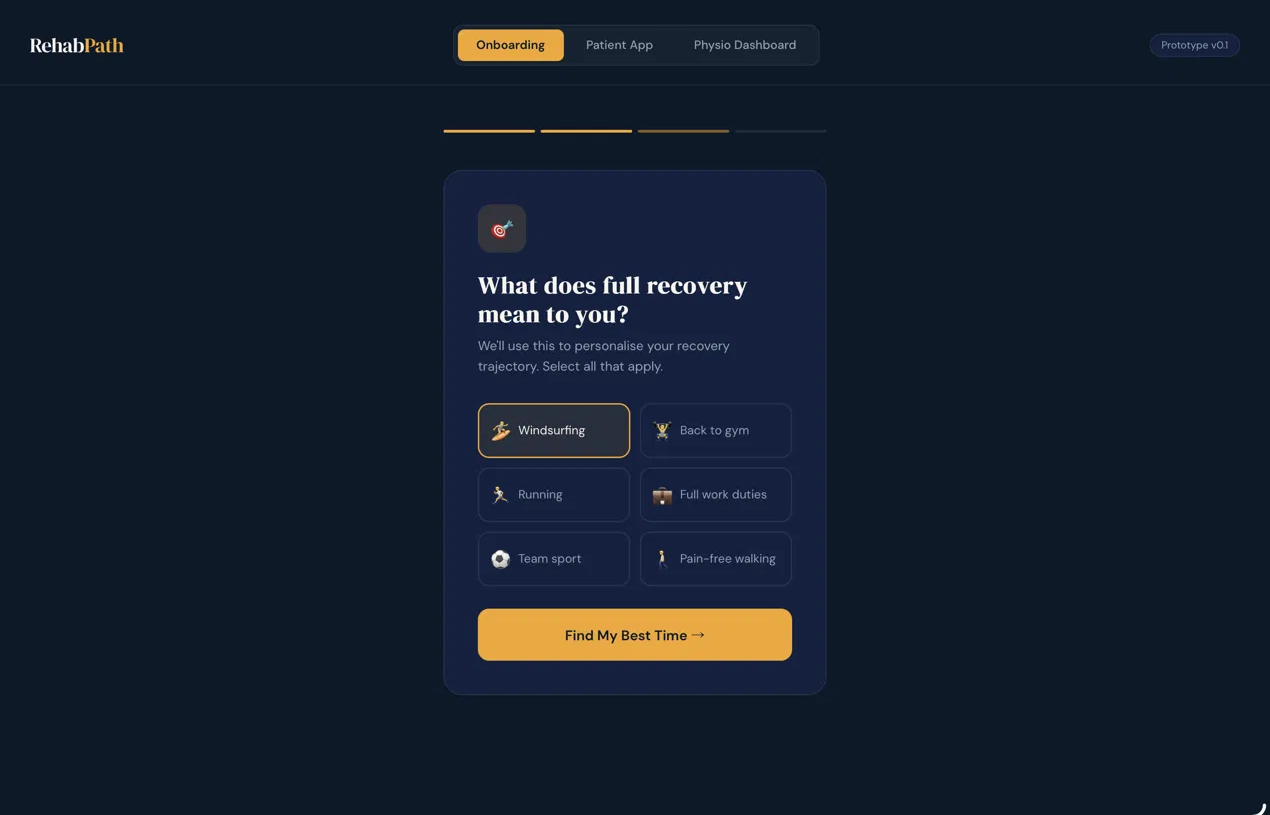
When a claim is lodged, the physio sends a secure invite link. The patient completes a short onboarding profile — building their behavioural baseline from day one.
RehabPath's behavioural engine tracks response signals across daily check-ins, adapting its messaging strategy to each patient's self-efficacy, pain stage, and dropout risk.
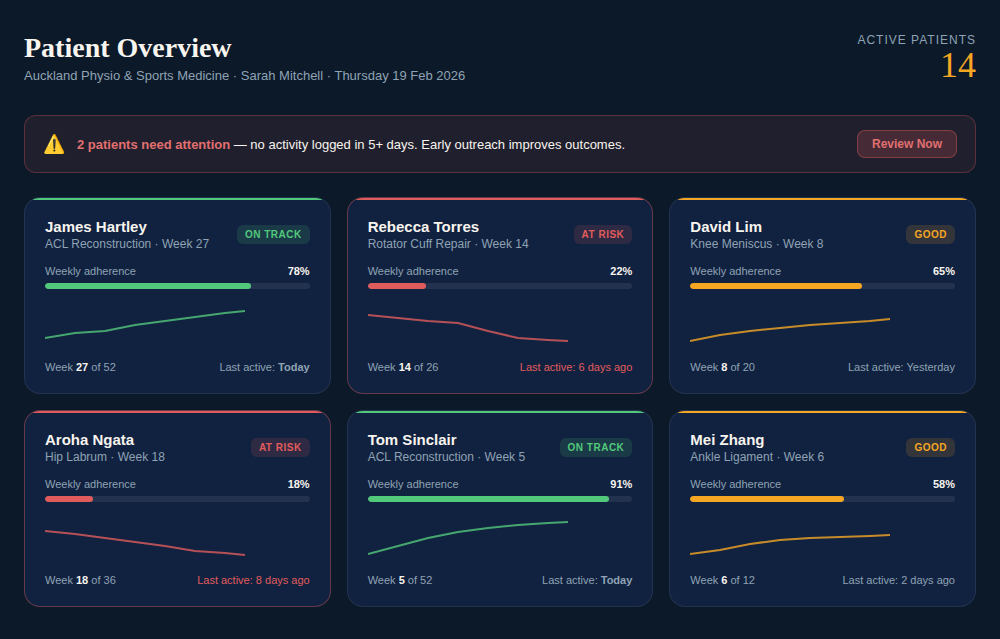
The physio dashboard surfaces adherence patterns and behavioural signals between appointments — making the clinical relationship continuous, not appointment-dependent.
This is the model RehabPath is built toward. The current pilot works differently: we're recruiting a small number of patients directly, without a physio referral in the loop, to generate real adherence data first. That data is what makes the physio-led model above worth building next. If you're a physio and want to see the results as they come in, get in touch.
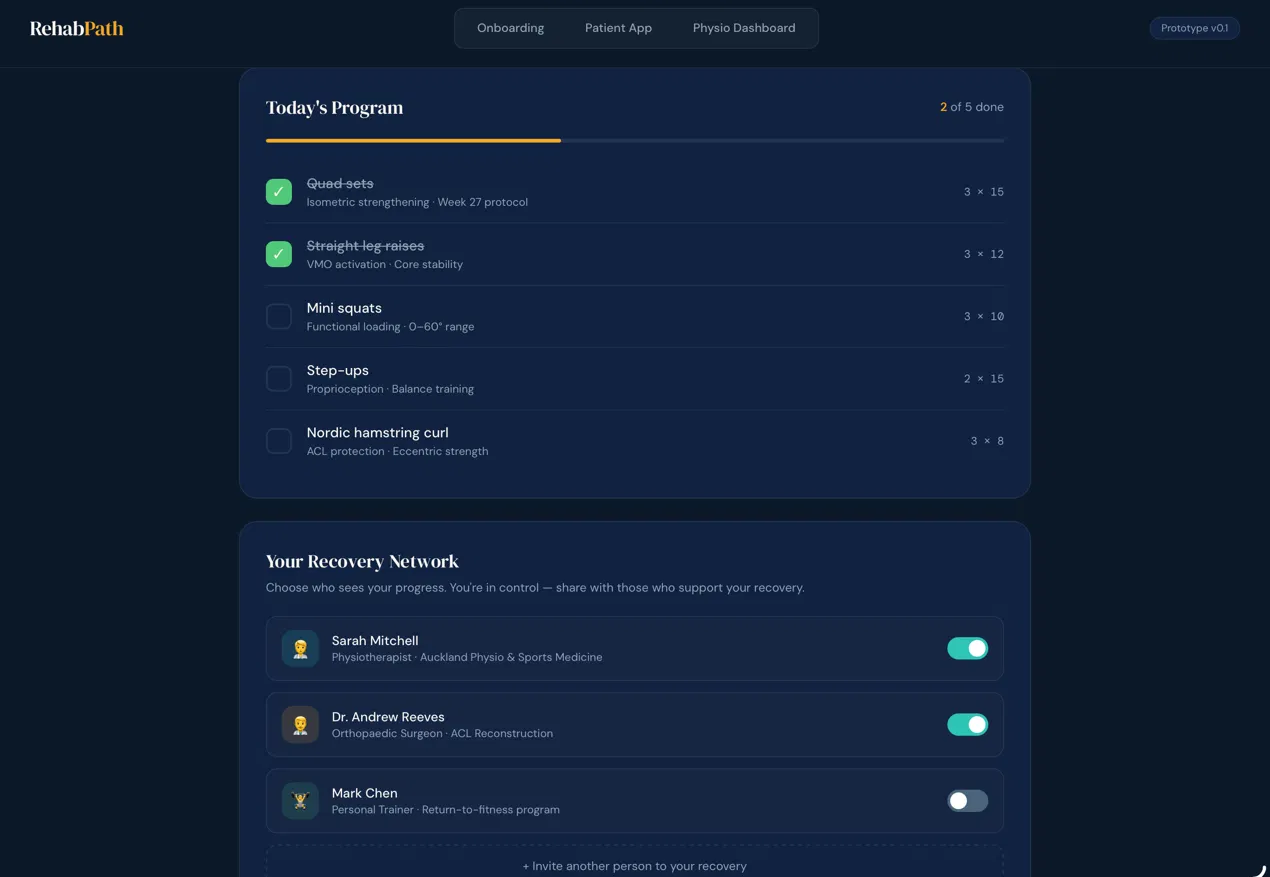
Patients see their exercises for the day — with completion tracking — alongside full control over who in their care team sees their progress.
RehabPath sits at the intersection of two urgent needs — clinicians who want their patients to actually recover, and a funding system under pressure to reduce claims costs. The long-term product is built for physios; the evidence to support that conversation is being built with patients first.
RehabPath extends your clinical impact beyond the clinic door — giving you visibility into patient behaviour and giving patients the nudge they need when you're not there.
We're currently building the evidence base with a direct patient pilot, ahead of asking for practice referrals — happy to share results as they come in.
The Practice Adherence Scorecard takes 5 minutes and gives you a structured picture of where your adherence gaps are — and what they're costing you.
Take the Adherence Scorecard →Improved adherence means patients recover more completely, return to independence faster, and are less likely to re-present. RehabPath directly addresses the self-management and digital tool recommendations from the 2025 Sapere market review.
Long-form pieces on rehabilitation adherence, behaviour change, and what the research says about why patients stop — and how to change that.
What ACC's own numbers tell MSK providers — and why "identify at-risk clients earlier" is the line worth sitting with.
Read → Behaviour changeWhy rehabilitation fails after the pain goes away — and what we're getting wrong about patient adherence.
Read → Clinical insightThe structural reasons patients disengage from home exercise programmes — and why it's not about motivation.
Read → ACC & fundingWhat ACC's published data tells us about physiotherapy claim patterns — and the opportunity it reveals.
Read →I studied sports science, spent years playing football and windsurfing, and thought I understood my body well enough to manage an injury. I was wrong.
In April 2025 I was invited to a friend's football training session. Within ten minutes I'd re-aggravated an old knee injury. I started ACC-funded physio treatment. I did the exercises when I was in pain. When the pain eased, I stopped — the way most people do, because the signal that tells you something is wrong had gone quiet.
In June 2025, while still under ACC-funded physio treatment, I played football with my son. I ruptured my ACL and required surgery.
I wasn't ignorant about rehab. I had the exercises. I had a physio. What I didn't have was anything to bridge the gap between appointments — no accountability, no context for why I still needed to do the work when I felt fine, and nothing to catch me when my motivation dropped at exactly the wrong moment.
That's what RehabPath is. Not an app trying to sell you something. A system designed to do the one thing that wasn't there when I needed it.
I'm a product manager by profession, not a clinician. RehabPath is grounded in peer-reviewed research on motivational strategies in rehabilitation — and tested with real people, in real recovery, from the start.
If you're a patient: one WhatsApp message a day for 14 days, a quick emoji check-in, and a short feedback conversation at the end. That's it. Nothing to buy, no follow-up pitch, no catch.
If you're a physio, or work at ACC or PNZ — I'd genuinely welcome a conversation about whether this is useful.
RehabPath's behavioural methodology is grounded in Bandura's self-efficacy model (1997) and informed by peer-reviewed research including Fernandes et al. (2023), Health Professionals' Motivational Strategies to Enhance Adherence in the Rehabilitation of People with Lower Limb Fractures, Int. J. Environ. Res. Public Health; Dobson et al. (2018), Exercise adherence in clinical populations, Clinical Rheumatology; and Lally et al. (2010), How are habits formed, European Journal of Social Psychology. Market context draws on the Sapere Physiotherapy Services Market Review, independently commissioned by ACC and Physiotherapy New Zealand, December 2025. All figures above represent published research estimates, not RehabPath outcome data.